College Track · in high school
Every step, laid out for you.
One season, narrowed
From every NCAA and NAIA program
to the one that signs them.
- 2,215college programs
- 15picked to start your player's list
- the ones with a gap at your position
- 1shirt
The narrowing is the product — scoring, roster math, and 5,545 coach addresses read off the schools’ own staff pages. The last step is the player’s. We don’t promise a signature and we don’t email a coach for you.
You're scored and fit for the College Track
Here's everything we do next — in order.
Five steps, each on the real screen it happens on, with a sample player in it.
- Step 1 of 5
We find your fit schools
Every program gets two honest scores, Athletic and Academic, ranked, with the reason behind each one.
2,215 programsSample player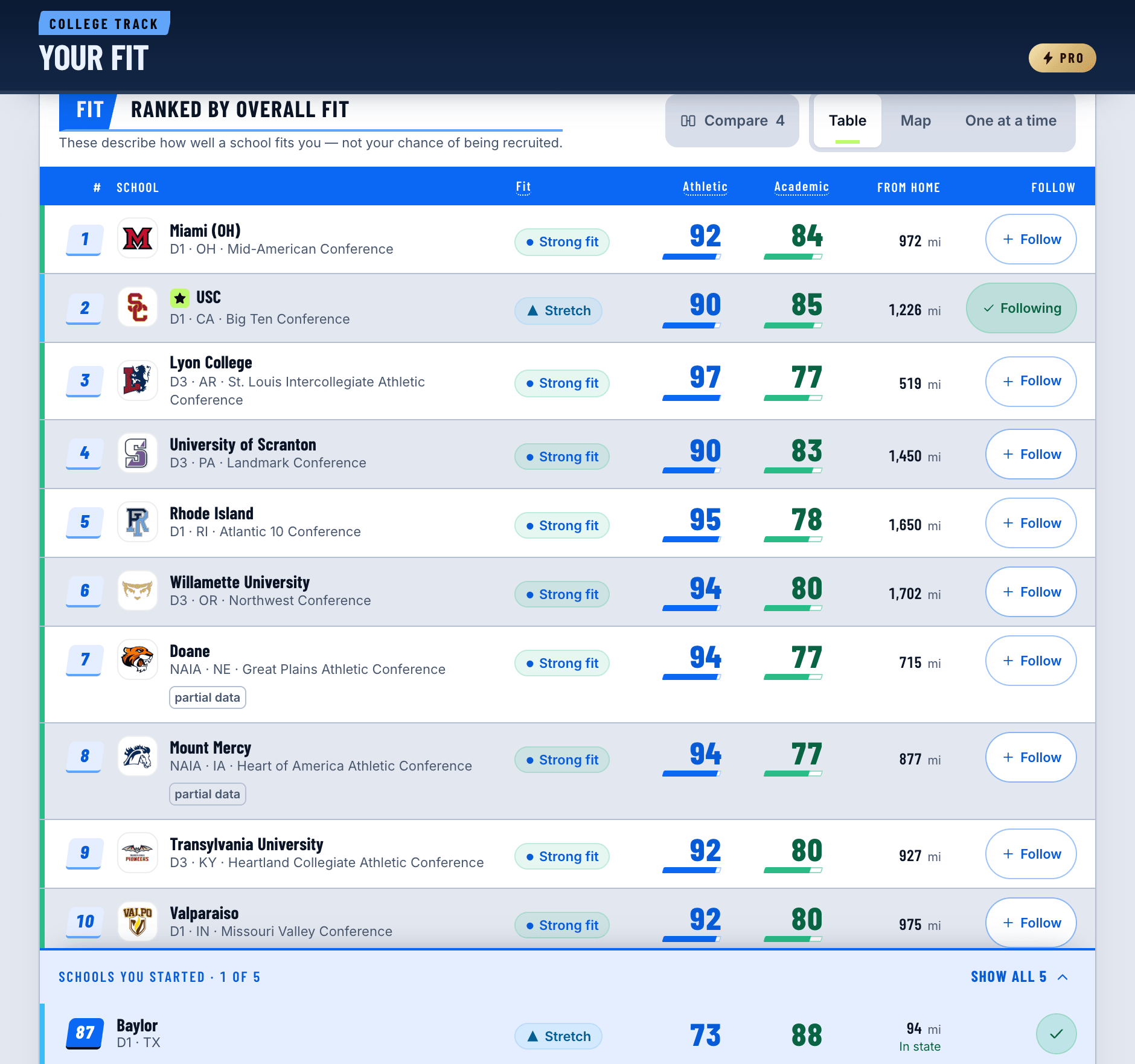
A screenshot of Startline with 3 regions highlighted and numbered, explained in the list below. - 1Two scores, never blended — Athletic and Academic stay apart. A great team at a school that would never admit your player is not a fit.
- 2Stretch, Strong fit or Fair fit — Stretch means the program recruits above your player's level. Strong and Fair fit are schools at it. A good list has a few Stretch schools and mostly Strong fits.
- 3Every division, ranked — D1 next to D3 next to NAIA, in one list. The division, state and conference sit under each name.
Sample player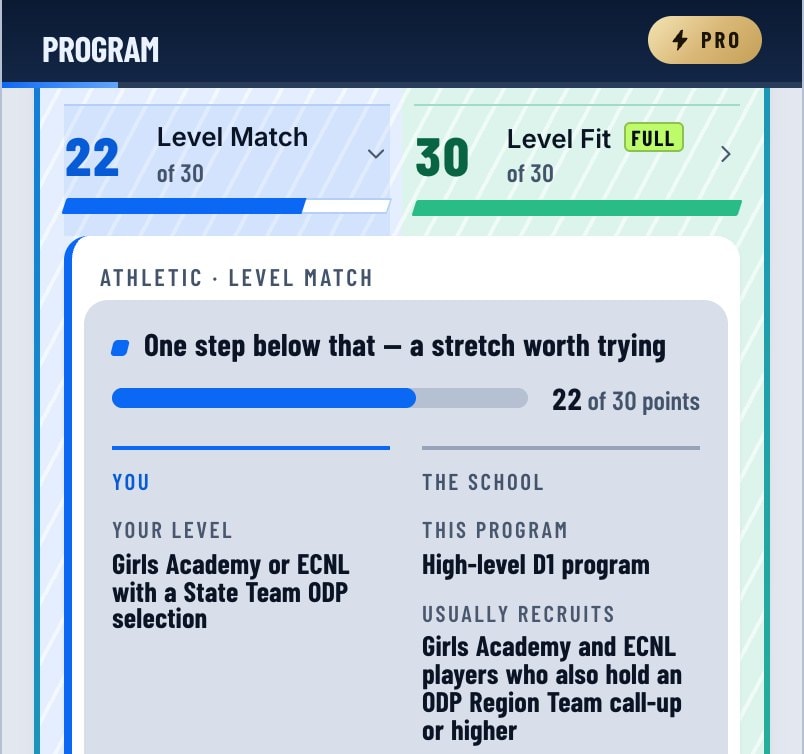 Sample player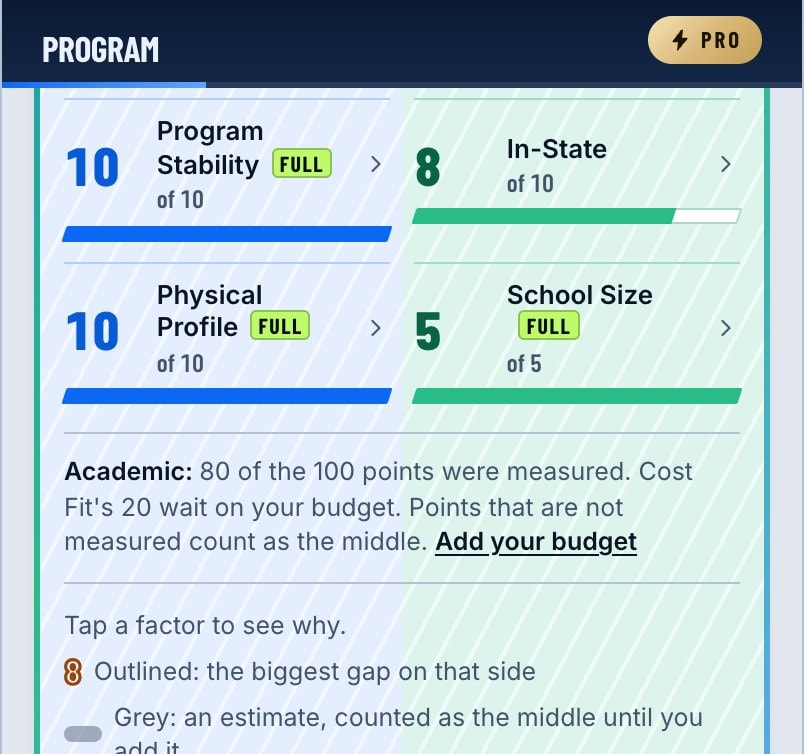
1/3 The list, two scores a school
- Step 2 of 5
Find the openings that are actually real
Who graduates at your position, how many are ahead of you, and whether the players a school signs actually stay.
66,998 roster spots readSample player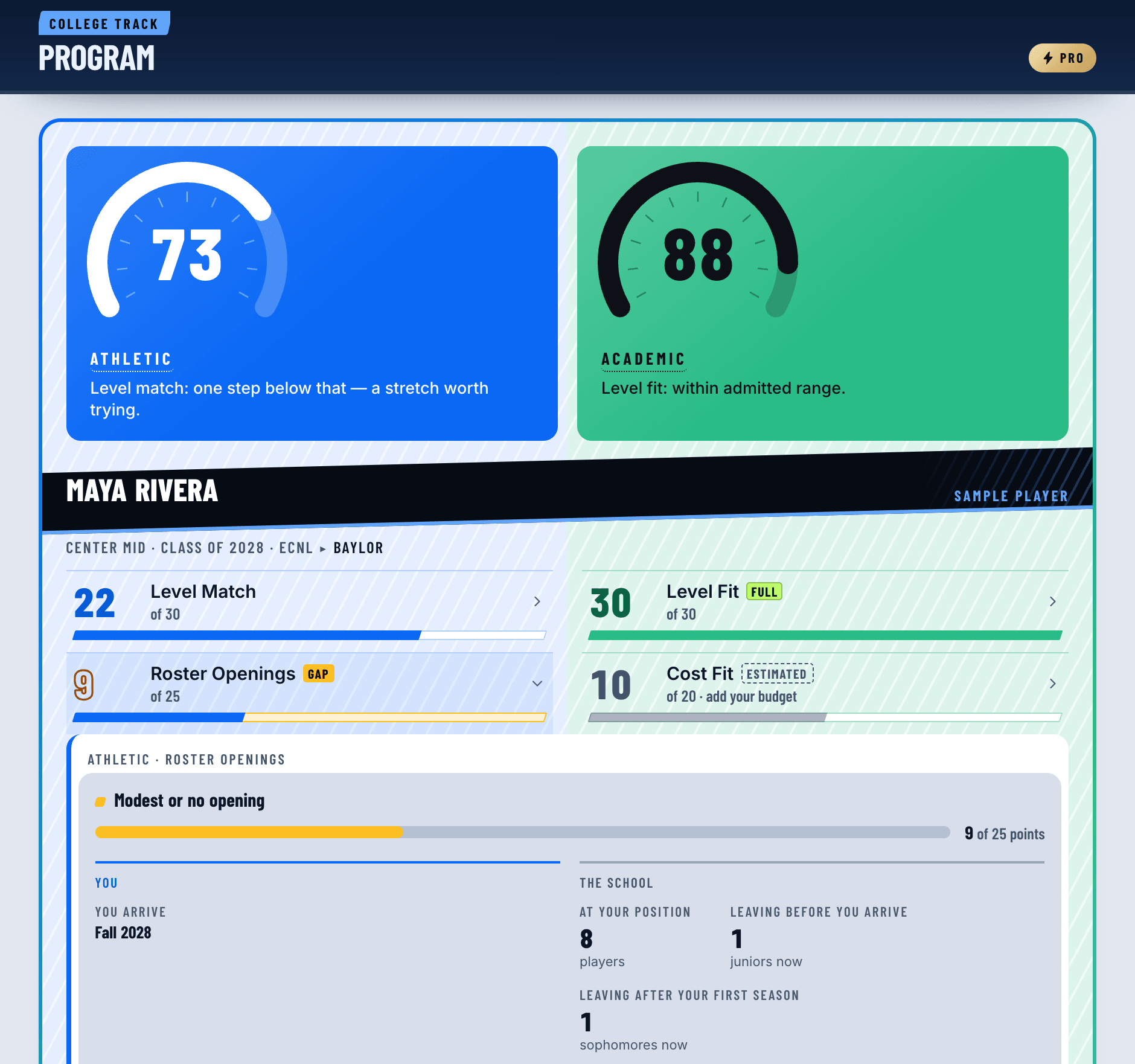
A screenshot of Startline with 3 regions highlighted and numbered, explained in the list below. - 1The athletic half — Can they play there: level, the real opening at their position, freshman minutes. Tap any factor under it to see why.
- 2The academic half — Judged separately, never averaged in. Where we hold too little of a school's admissions record, it says so instead of printing a number.
- 3Who actually graduates — Read off that program's own published roster: who leaves at this position and who is ahead. Dated, not estimated. This is 25 of the 100 athletic points.
Sample player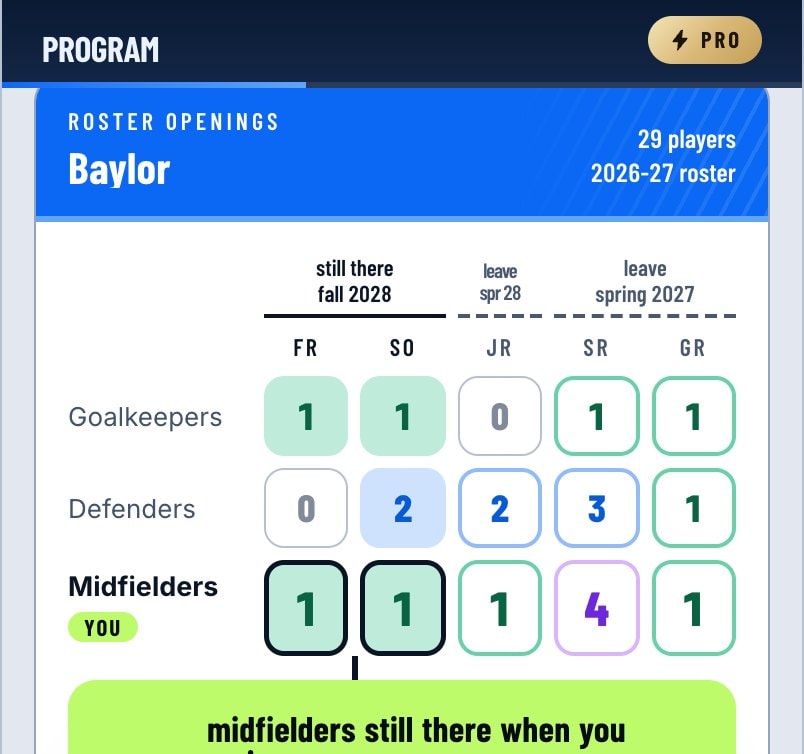
1/2 One school, opened
- Step 3 of 5
Reach the right coaches with the right facts
Drafted from that program's roster need, the class graduating at your position and your grades — then edited by you and sent from your own inbox.
8+ live data pointsSample player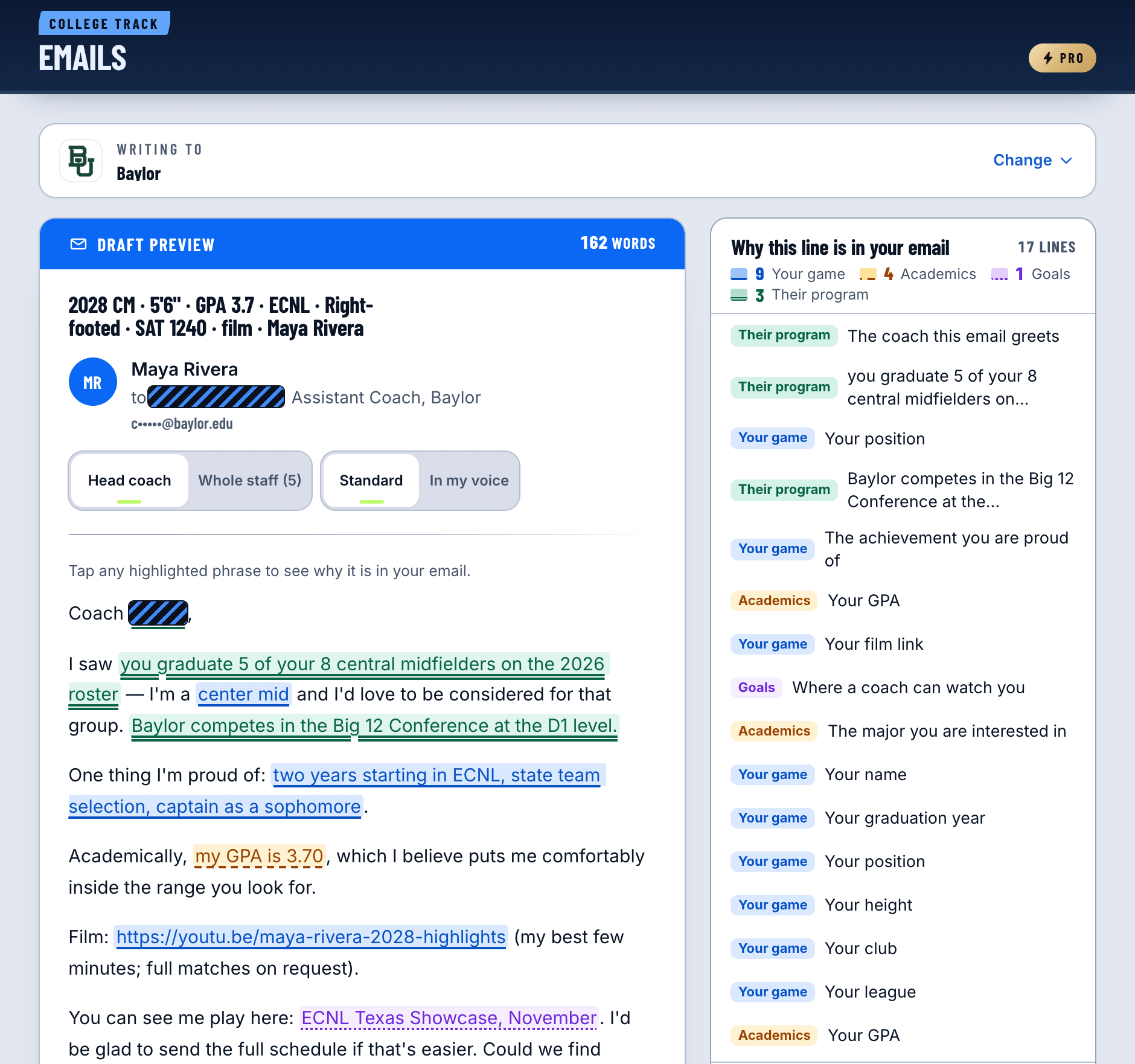
A screenshot of Startline with 3 regions highlighted and numbered, explained in the list below. - 1A real coach, by name — The coach who runs that program's recruiting inbox, read off the school's own staff page — not a generic soccer@ alias. (Name and address are hidden in this picture.)
- 2Opens with their roster — The first line is that program's own graduating class at this player's position: proof the email was not sent to two hundred schools.
- 3Every fact, color-coded to its source — Every highlighted line is listed with where it came from — your game, your academics or that program's own record — so you can see nothing in the draft was made up.
Sample player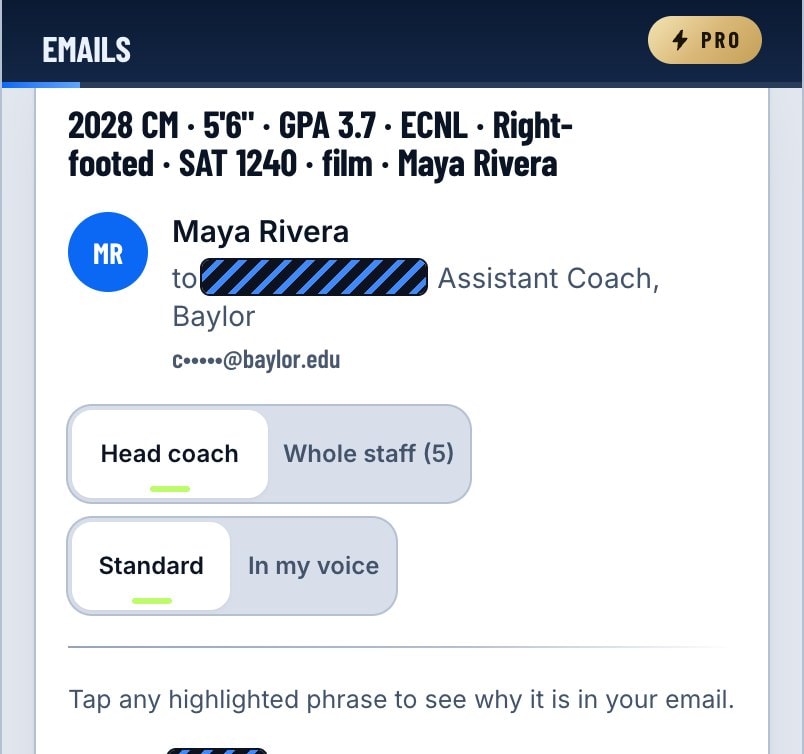
1/2 The email, facts marked
- Step 4 of 5
Be on their radar before you ever show up
Families burn the most money at ID camps and drive home unseen. We hold the coach contacts for the host schools, so you arrive as a name they expect.
1,909 campsSample player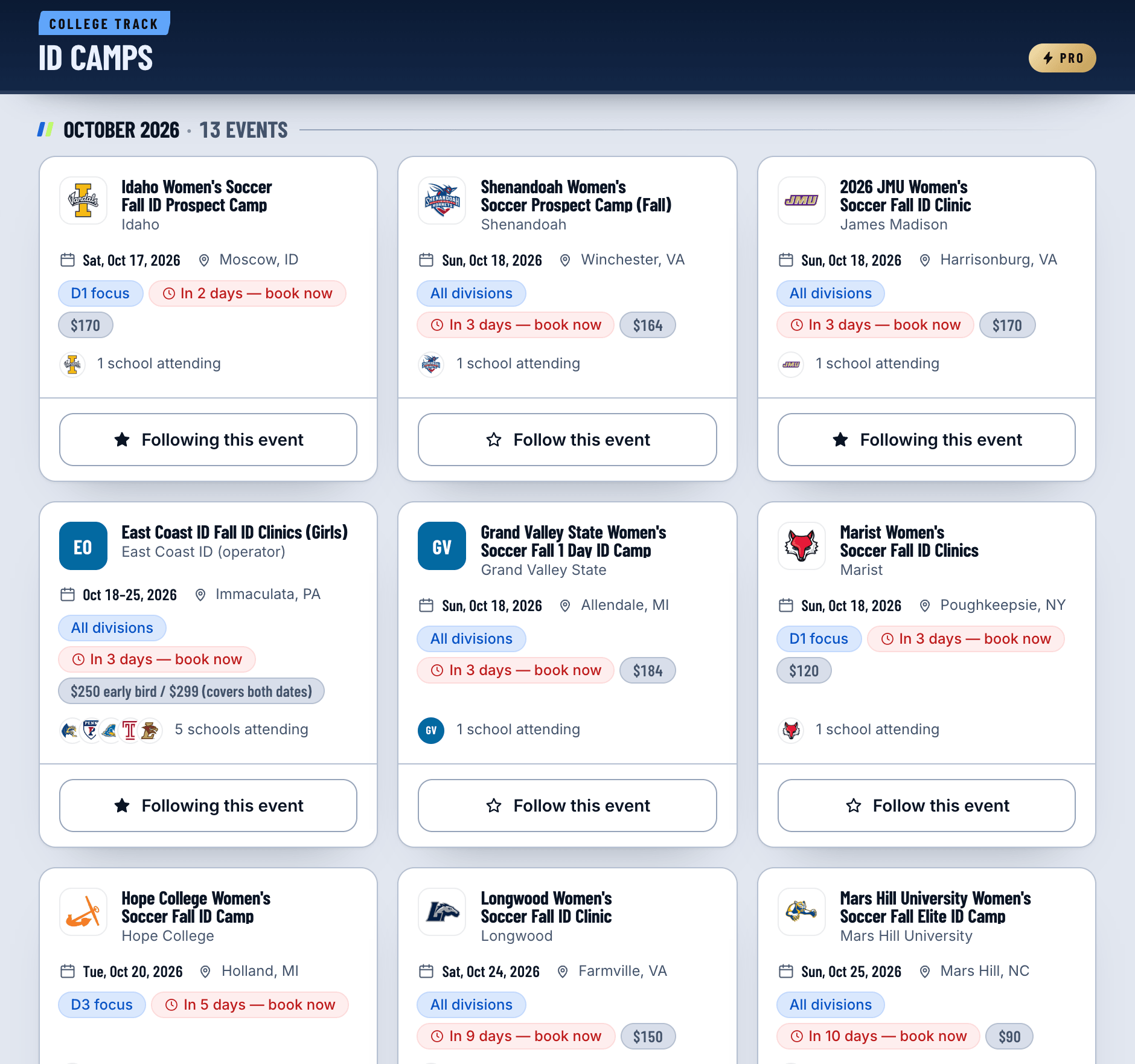
A screenshot of Startline with 3 regions highlighted and numbered, explained in the list below. - 1Real date, real venue — Where a school has published one. Camps that haven't posted a date say so instead of guessing at one.
- 2Who is in the room — Which schools send staff. That is the whole reason to pick one camp over another.
- 3Nothing invented — The fee comes straight from the host's own page. Where a school hasn't published one, the card leaves it out rather than guessing.
Sample player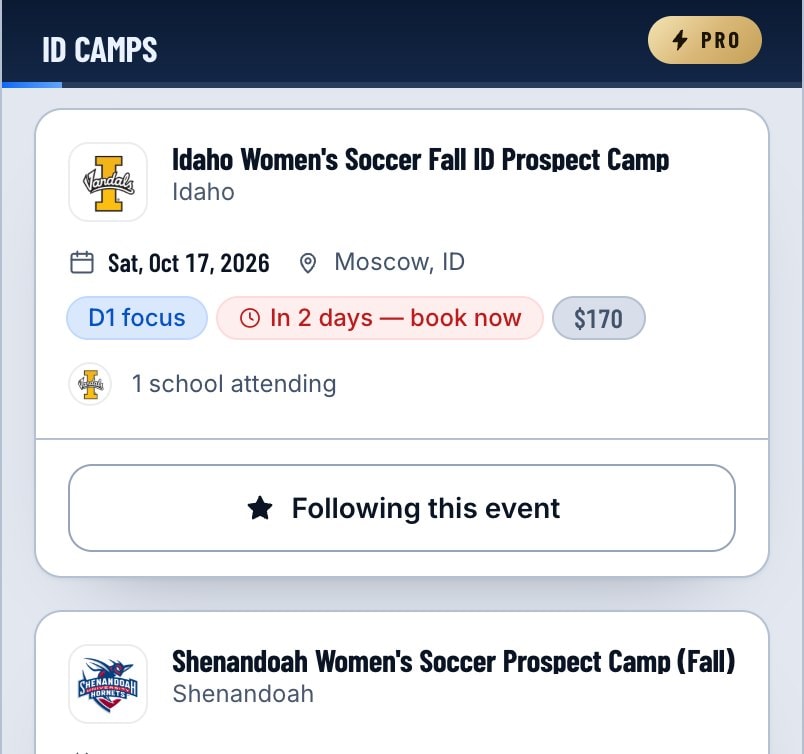
1/2 Every camp, by date
- Step 5 of 5
Track it all the way to a commitment
One board for every coach conversation, first message to offer. Forward a coach's reply to your private tracking address and your answer is drafted, to give you the best opportunity to get a response; you review and send it. A nudge drafts itself when a coach goes quiet.
first message → offerSample player · results illustrative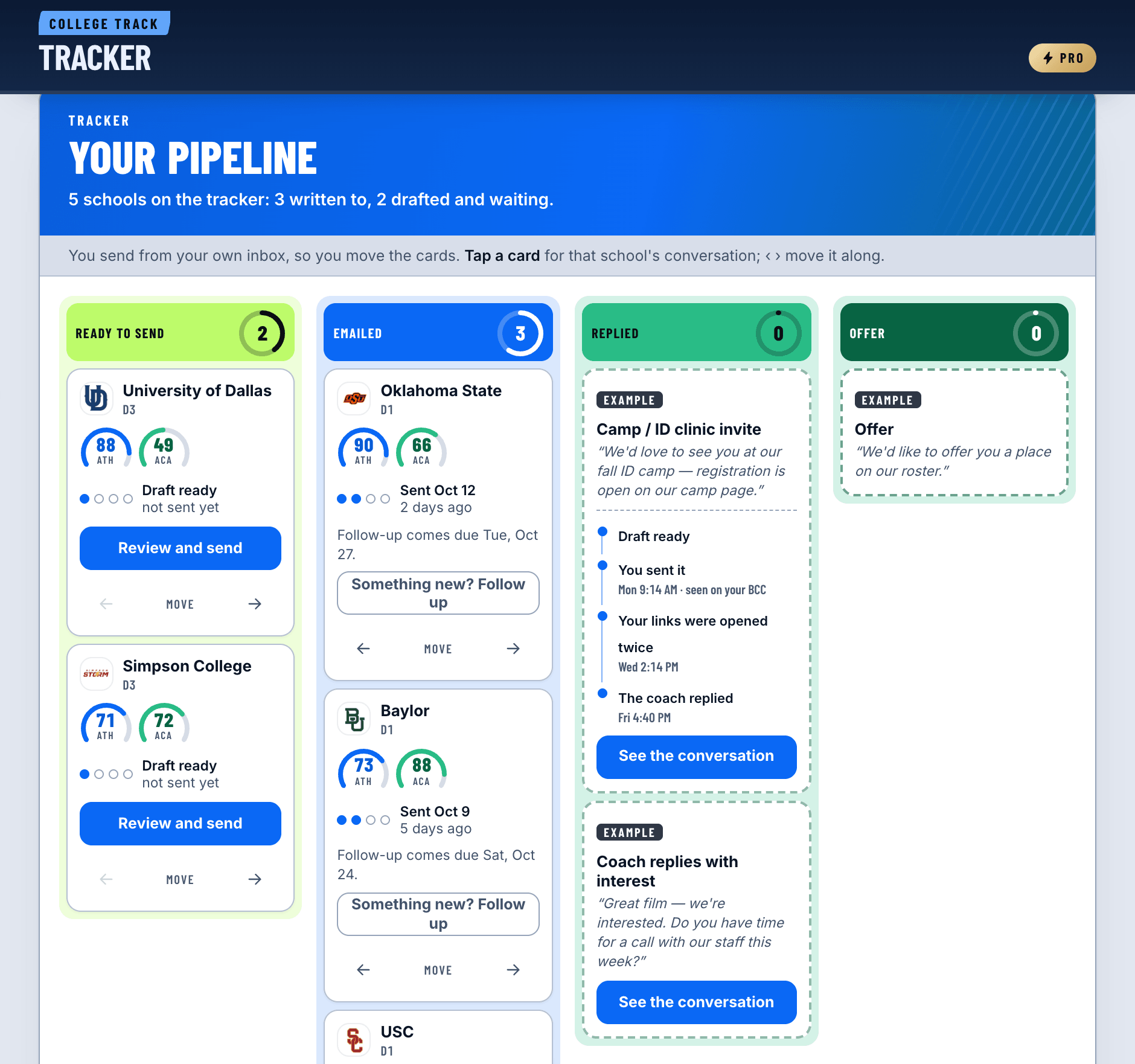
A screenshot of Startline with 3 regions highlighted and numbered, explained in the list below. - 1Four stages, one board — Ready to send, emailed, replied, offer. Every school your player is talking to, in one place.
- 2Both scores on the card — So a school moving down the board is always read next to how well it actually fits.
- 3The nudge, dated — Fourteen days of silence is a second touch, not a no. The follow-up dates are kept for you.
Sample player · results illustrative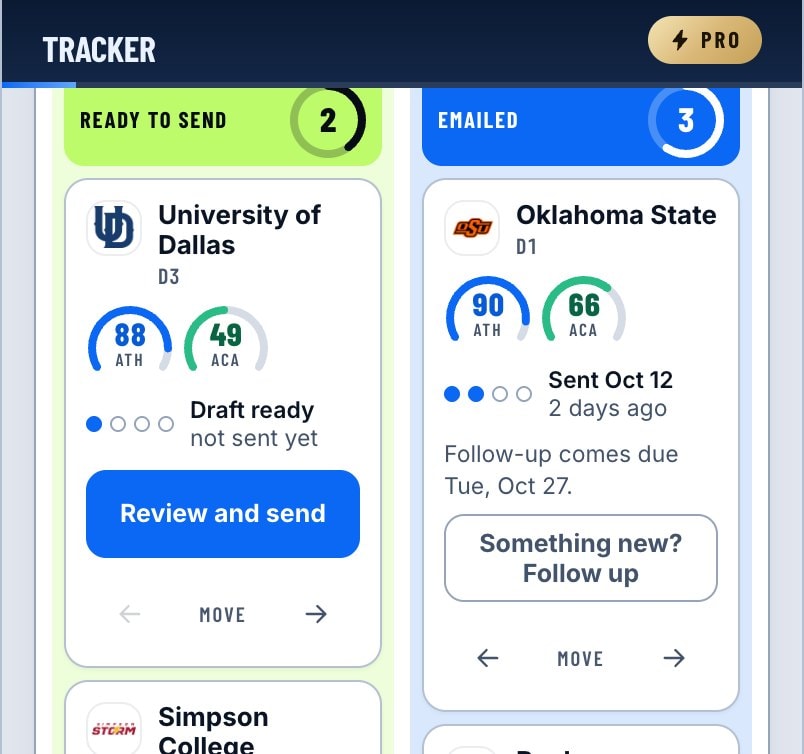 Sample player · results illustrative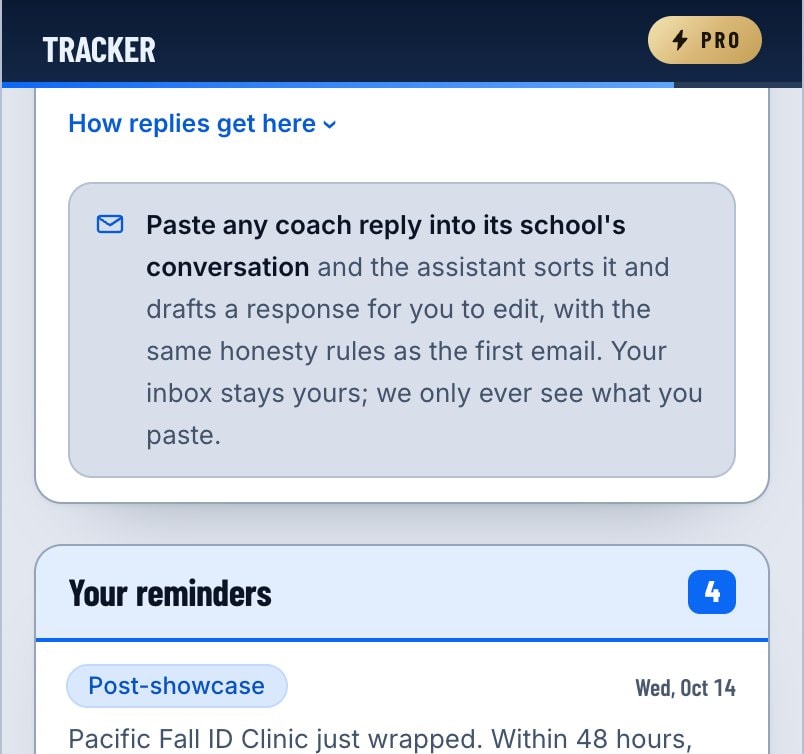
1/3 Every school on one board
Soccer recruiting + AI
Powered by AI. Run by a person.
25 jobs keep Startline running, and 8 of them use AI, for words. The two Fit Scores are computed by fixed rules, so the same answers always give the same scores.
Writes in their voice
Two minutes of talking, and each coach email can be put in your player's own words. The facts in it do not change.
Reads school news daily
For the schools you follow, one line worth mentioning to the coach, with its link.
Rewords a reply on request
Say what you do not like about a drafted answer to a coach and AI rewords it, adding nothing new.
Reads their game film
Points to the moments worth keeping in a highlight reel, each with its time in the film. No rating.
Talk for two minutes. Get coach emails that sound like you.
Your browser writes your words down as you speak; our AI learns how you talk and rewrites each draft in your voice — facts, numbers and links untouched.
College Track · your list
See your best-fit schools free
Build a profile and get your ranked list — one school you activate, no credit card.
Before you start
The questions families actually ask
When can a college coach actually write back?
D1 coaches can call, text or email a recruit from June 15 after sophomore year. D2 coaches can write to a recruit of any age (since August 2024); in-person contact and visits wait until June 15 after sophomore year. D3 and NAIA coaches have no date restriction. So a D1 coach who is silent before June 15 is following a rule, not giving a verdict.
How do you know a coach replied?
You tell us, once, and it runs from there. Your account has a private tracking address. BCC it when you email a coach and that school moves to Emailed. Forward a coach's reply to it, or set your inbox to forward coach replies, and the reply lands on your board, the school moves to Replied, and an answer is drafted for you from your player's profile. You review every reply and send it from your own inbox. We read only what you send to that address, never your inbox. If your email carries your player link, the board also shows when that link was opened.
How many schools should we email?
Enough to cover the range. A list that is all Stretch schools and a list with none fail the same way. A good list has a few Stretch schools and mostly Strong fits. We sort every school against your player's own list so you can see the spread before you send anything.
Do we have to go to ID camps?
No. A blanket camp invitation is marketing, not recruitment — the ones worth the drive are the ones staffed by schools already on your list. We hold 1,909 and show you which of your schools attend each.
How current is the roster data?
2,194 of the 2,215 programs are on their 2026-27 squad — the season being played right now — and the roster page itself confirms it. 18 had not posted a new roster when we last read them, so you see last season's with the date on it; 3 post a roster whose page doesn't say which season it is; and 0 publish no roster we can read at all. Every school page carries the date we last read that one.
Transfer Track · already in college
Thirty days. Pick better.
Where transfers land
at leastShare of each division's roster that arrived from another college.
- NAIA14.1%
- D29.2%
- D16.9%
- D34.4%
Bars are relative to the highest share, not to 100%. A floor, not a full count — we can only read the schools a roster actually spells out.
Start from the date
Your window, not last year's.
The NCAA moves these dates every year. We show the last cycle it confirmed, and say plainly when the next one isn't out yet.
The transfer window
The NCAA Eligibility Center’s own PDF, published 2026-04-07.
Last published cycle
2025-26- Men's soccer30-day window
Monday, Nov. 24, 2025 – Tuesday, Dec. 23, 2025
- Women's soccer30-day window
Monday, Nov. 17, 2025 – Tuesday, Dec. 16, 2025
- Spring windowBoth sides, 15 days
Friday, May 1, 2026 – Friday, May 15, 2026
The NCAA sets these annually and they move with each championship. We publish the last cycle it confirmed rather than a guess at the next one.
Once you know the date
Five moves, in the order the clock allows.
Everything here comes from your profile and that program's live roster: the College Track's engine, reading your current division instead of a youth league.
- Step 1 of 5
Start from the date, not the list
The window opens, runs about 30 days and shuts. Your date comes first — and if the NCAA hasn't published this year's yet, we say so rather than guess.
~30 days - Step 2 of 5
Find the programs that actually sign transfers
At least 67% of the programs whose rosters we can read — 1,379 of 2,068 — already have a player from another college. We can see which staffs rebuild from the portal every year, so your list is staffs that have done this before.
67% already took a transferSample player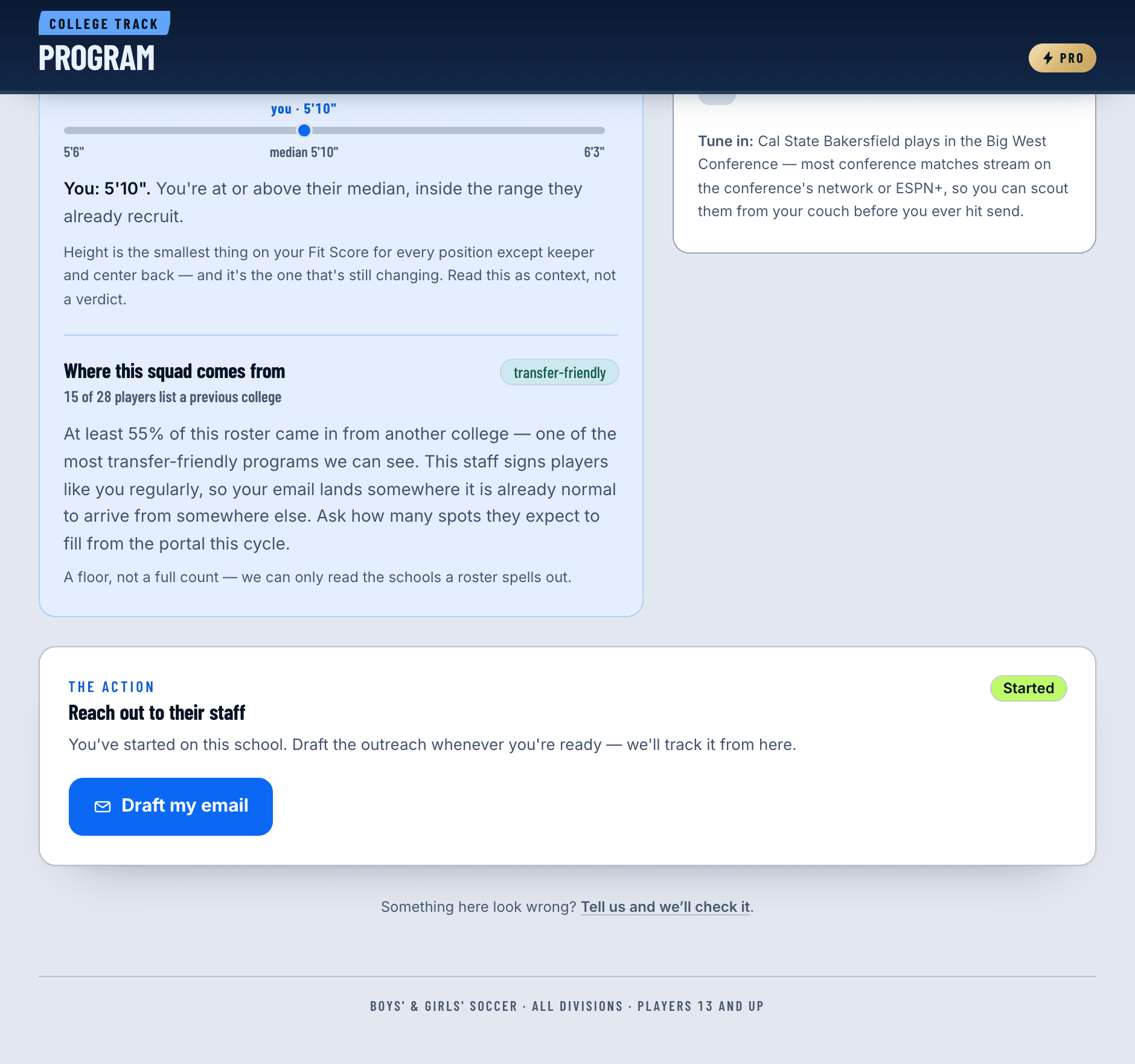
A screenshot of Startline with 3 regions highlighted and numbered, explained in the list below. - 1The same number, the other way round — This number warns a high-school recruit that the openings here are spoken for. For you it says the opposite: this staff signs college players, every year.
- 2Tagged on the program itself — Only programs we can prove fill a fifth or more of their roster from other colleges carry this. 189 of the 2,068 we can judge.
- 3The count behind the share — The raw count behind the percentage, so you can see how much roster it was read from.
Sample player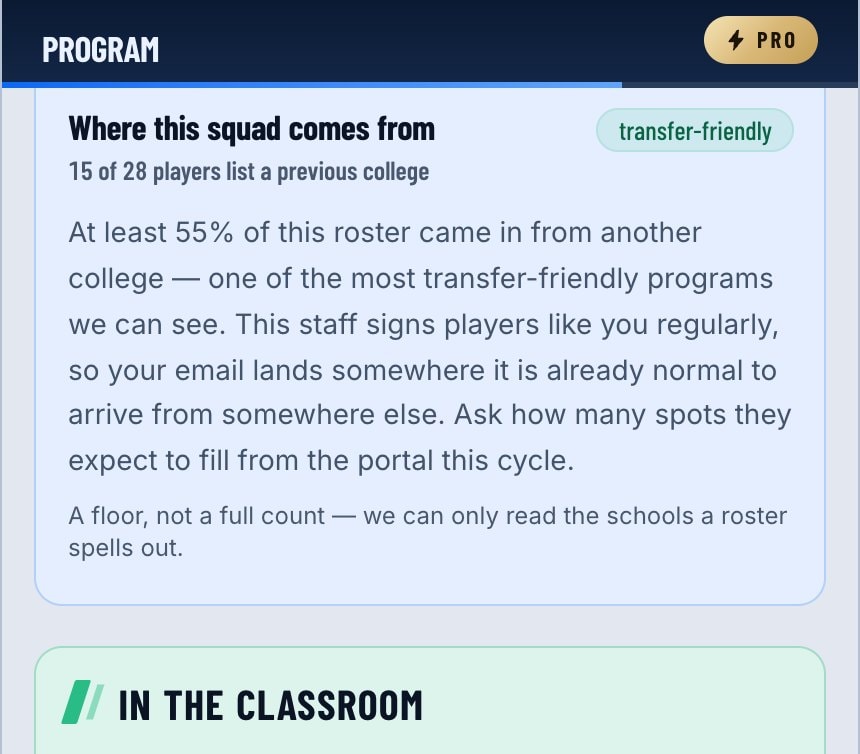
1/2 Where this squad comes from
- Step 3 of 5
Judge the opening before you spend a season on it
Who graduates at your position, how many are ahead of you, whether freshmen play, and whether the players they sign stay. You already made this decision once on less.
66,998 roster spots readSample player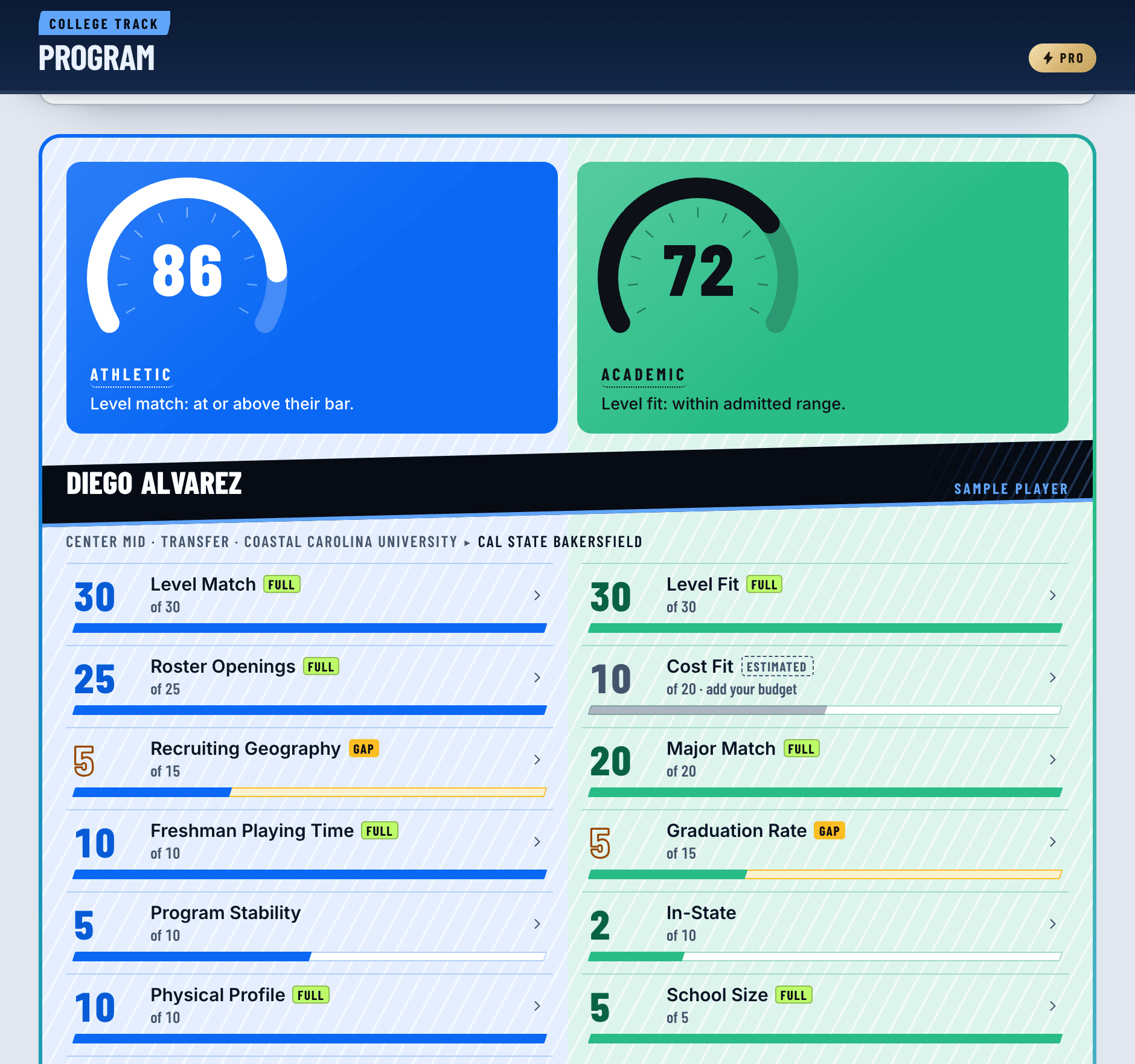
A screenshot of Startline with 3 regions highlighted and numbered, explained in the list below. - 1Where the points are going — On each score, the factor losing the most points gets a GAP tag and an outlined number, so you know what is holding this school back before you open a row.
- 2Scored off the division you play in — A high-schooler's level is inferred from a youth league. Yours is measured: you already compete at a division, so Level Match is the most reliable number this engine produces.
- 3The bar fills with the points you earned — Every factor has a bar under it. The filled part is what you scored out of what that factor is worth, and the open part is the points still to win.
Sample player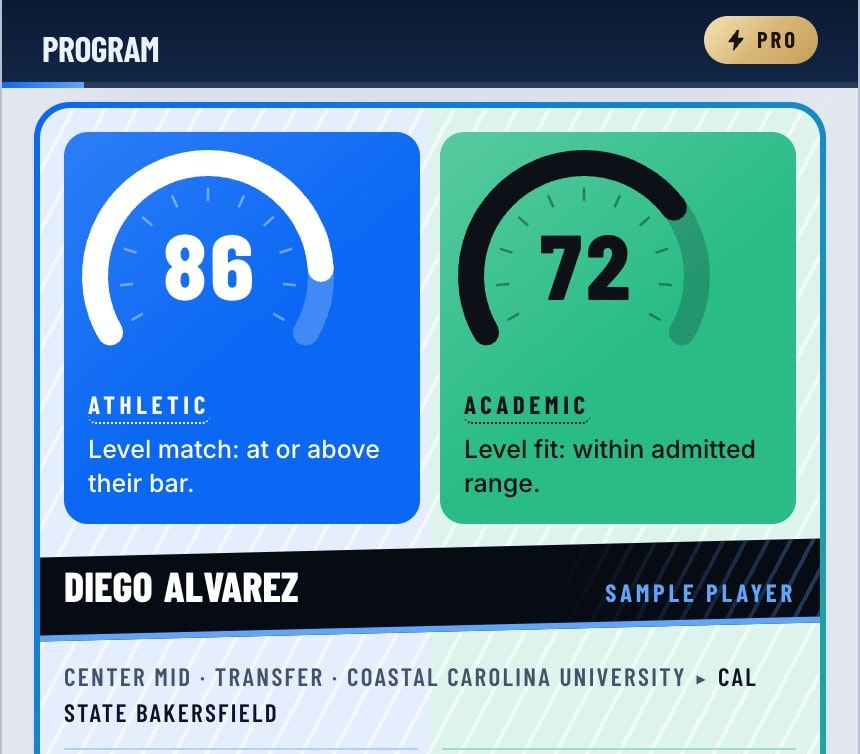
1/2 One school, both scores
- Step 4 of 5
Lead with the two things a coach asks first
Eligibility left and the level you play now: every staff asks in the first reply. Your emails open with both, written per program from its own roster need.
5,545 addresses on fileSample player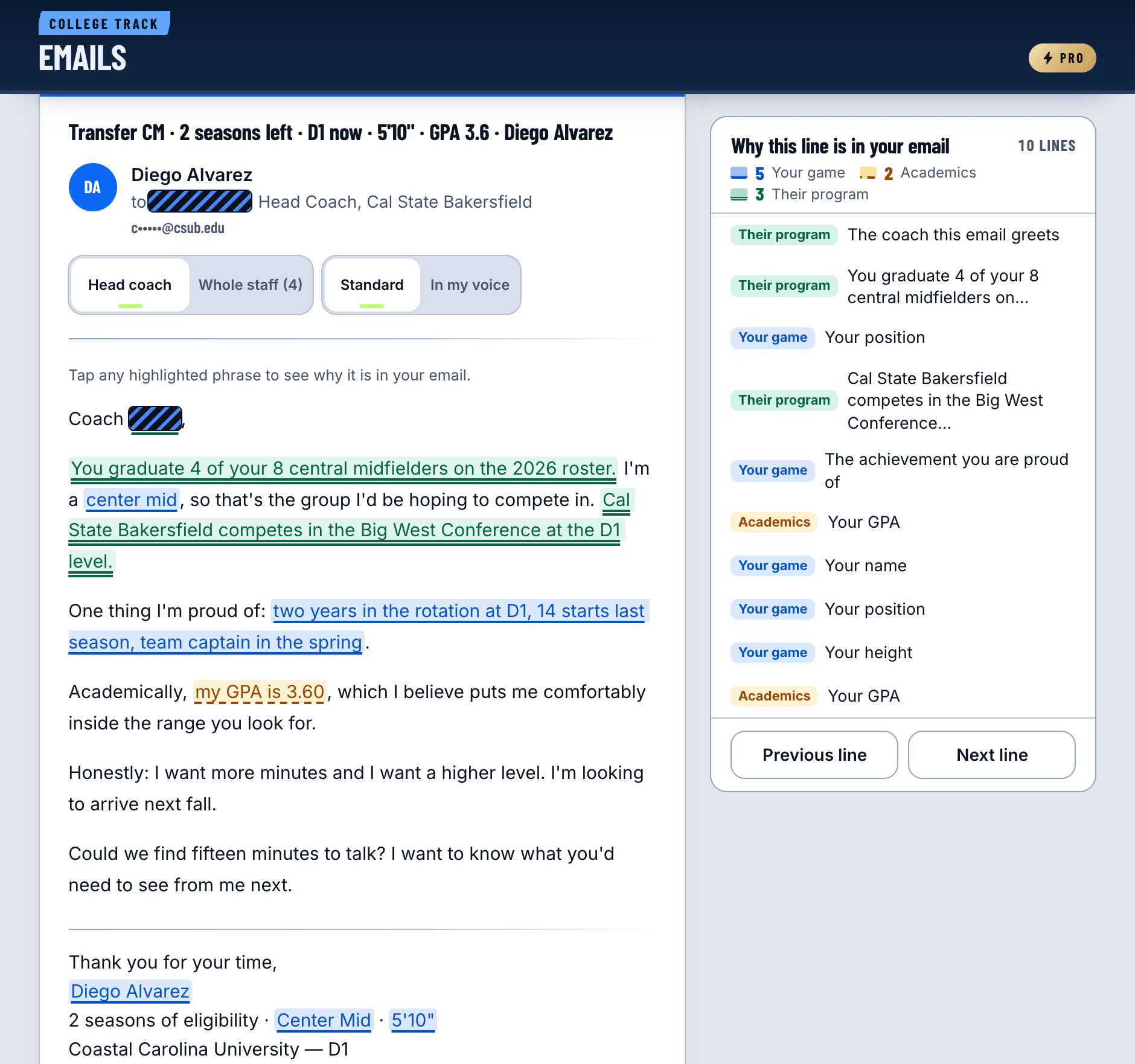
A screenshot of Startline with 3 regions highlighted and numbered, explained in the list below. - 1Signed off with your eligibility — Seasons of eligibility left, your position and your height, on the line under your name — there before anyone has to ask.
- 2A subject line built to be triaged — Transfer, position, seasons left and the division you're in now — the filters a coach with 200 unread emails actually sorts on, in the 78 characters a phone will show.
- 3Named staff, not a front desk — One named coach or the whole staff, your call — and it sends from your own inbox, so the reply comes back to you rather than to us.
Sample player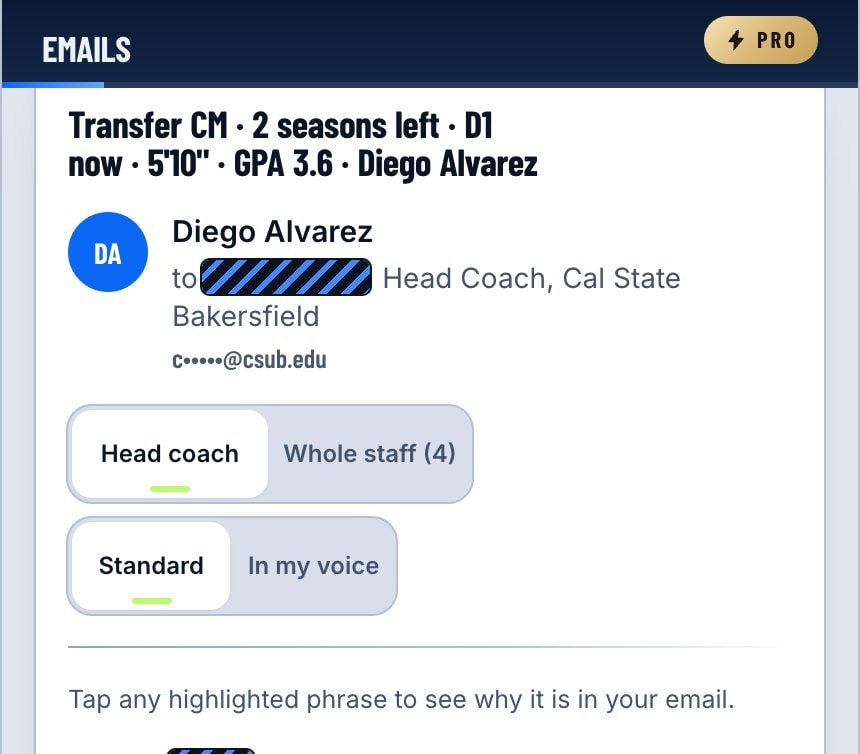
1/2 The email, facts marked
- Step 5 of 5
Run it like the sprint it is
One board for every conversation, a nudge that drafts itself when a staff goes quiet, and the window's remaining days on top of it. Thirty days is not long enough to lose track of who you wrote to.
notify → signedSample player · results illustrative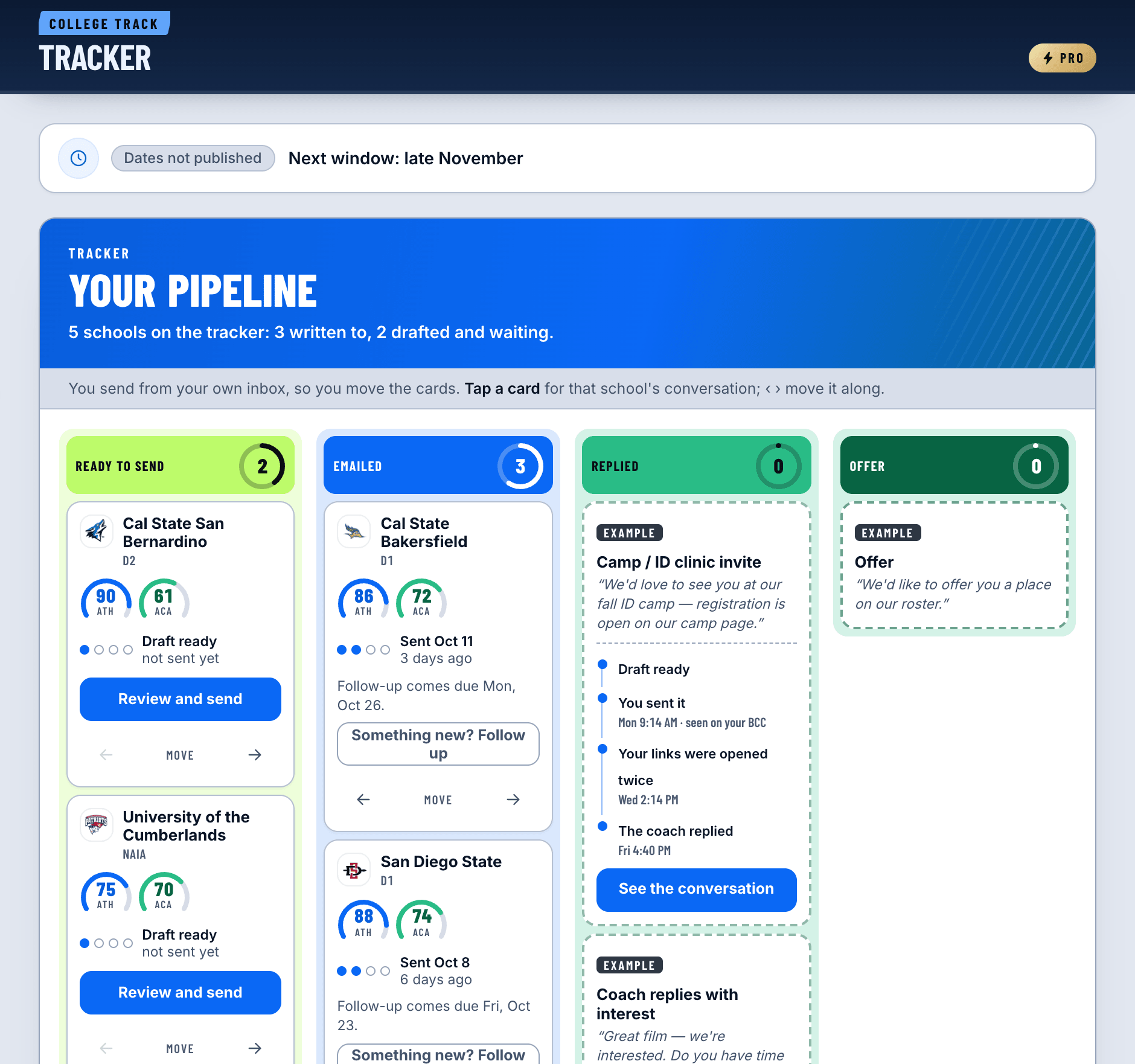
A screenshot of Startline with 3 regions highlighted and numbered, explained in the list below. - 1Every stage, one board — First message to offer, with the follow-up dates kept for you.
- 2Where each school actually stands — Moved by what happened, not by what you meant to do — a reply pastes straight in and we read back what they asked.
- 3The programs you chose — The same schools your Fit Score ranked, carried through to the outreach — you never rebuild the list.
Sample player · results illustrative
1/2 Every staff on one board
Soccer recruiting + AI
Powered by AI. Run by a person.
25 jobs keep Startline running, and 8 of them use AI, for words. The two Fit Scores are computed by fixed rules, so the same answers always give the same scores.
Writes in their voice
Two minutes of talking, and each coach email can be put in your player's own words. The facts in it do not change.
Reads school news daily
For the schools you follow, one line worth mentioning to the coach, with its link.
Rewords a reply on request
Say what you do not like about a drafted answer to a coach and AI rewords it, adding nothing new.
Reads their game film
Points to the moments worth keeping in a highlight reel, each with its time in the film. No rating.
Talk for two minutes. Get coach emails that sound like you.
Your browser writes your words down as you speak; our AI learns how you talk and rewrites each draft in your voice — facts, numbers and links untouched.
Why we can do this
The signal that warns a high-schooler is the one that helps you.
If you're in high school
“At least 40% of this roster came in from another college.” Four graduating seniors looks like four chances — but if the staff fills those spots from the portal every year, almost none of them are yours.
If you're transferring
Same roster, same 40%, opposite meaning. This is a staff that signs college players every year, has processed the credits before, and reads an email from somebody already on a roster as completely normal.
We read 61,711 roster entries to work out which programs are which. At least 67% of the 2,068 we can judge — 1,379 programs — already have a player who came from another college. 189 of them fill a fifth or more of the squad that way. Both are floors: we can only read the schools a roster spells out.
The rules, with receipts
What changed, and what it means for you.
Two of these changed inside the last year. Every one links its source. Check us, and check with your compliance officer before you plan around any of them.
- NCAA Division I
You can transfer more than once
Since April 2024 there is no limit on how many times you transfer. You play immediately at the new school as long as you left the last one academically eligible and in good standing, and you meet progress-toward-degree where you land. The one thing you cannot do is move mid-year and play for two schools in the same season.
Source - NCAA Division I
The window is 30 days, and it is the whole ballgame
You tell your current school you intend to transfer, and they enter you in the portal. That notification can only happen inside the window — a roughly 30-day stretch after the season for fall sports, plus a 15-day window in May. Miss it and you are waiting a full year.
Source - NCAA Division I
If your head coach leaves, you get your own window
A head-coaching change opens a separate 30-day window for that team's players, whatever the calendar says. If the person who recruited you is gone, you are not locked in behind the normal dates.
Source - NCAA Division IIIchanged this year
Division III now uses the portal too
As of August 1, 2026, a player moving from any four-year college into Division III goes through the transfer portal rather than the old permission-to-contact letter. You notify your school, and it has seven calendar days to enter you. The D3 self-release still exists for talking to other D3 programs.
Source - NAIA
NAIA runs its own process
NAIA schools do not use the NCAA portal. Going the other way — NAIA into NCAA D1 or D2 — you register with the NCAA Eligibility Center and get a permission-to-contact release from your current athletics department, because most NCAA coaches will not talk to you until that exists.
Source - NCAA Division Ichanged this year
The eligibility clock changed in 2026 — check yours
Division I approved a model giving five seasons of competition across five years, with the clock starting at full-time enrollment or the academic year after you turn 19, whichever comes first. It runs continuously, so sitting out no longer stops it. Players already enrolled are in a transition period where the school applies whichever model helps them more. This one is genuinely new — confirm your own count with a compliance officer before you plan around it.
Source
Transfer Track · your window
See where you actually fit
Build a profile in a few minutes and get every program ranked for you — one school activated, no credit card.
Before you enter
The questions players actually ask
How is this different from just emailing coaches myself?
You can email anyone. What you can't do by hand is tell which programs actually sign transfers — we read 61,711 roster entries to find the 189 that fill a fifth or more of their squad from other colleges. That's a list of staffs who have done this before, not a generic ranking.
When can I actually enter the portal?
There's a window of about 30 days after the season, and a second 15-day window in May. You tell your school, and they enter you. The NCAA publishes exact dates each year and they move — we show you the last cycle it confirmed and link the official list rather than guessing at the next one, because most sites just roll last year's dates forward.
Will transferring cost me a year?
Not on its own. Since April 2024 there's no limit on how many times you transfer, and you play immediately as long as you left academically eligible and in good standing and you meet progress-toward-degree where you land. The eligibility clock itself was rewritten in 2026, though, so confirm your own count with a compliance officer — we tell you what changed and point you at the source.
I'm at a junior college or playing overseas. Does this work?
Yes for the part that matters: every four-year program we hold is scored for you the same way. What we won't do is pretend to rank your current school — we hold no NJCAA program data yet, though we're adding it about a month after launch, and for an overseas club we say we can't read your level rather than inventing one. You'll see that stated on your score, not buried.
What do you actually know about a program's openings?
Who graduates at your position, how many players sit ahead of you, whether freshmen get minutes, and whether the players they sign stay — read from 66,998 published roster spots. Public rosters don't show incoming commits or portal moves, and we date every roster so you know how fresh it is — most are the 2026-27 squads now on the field.

Youth Track · still climbing
The next club up.
The club ladder
1,971 club teams · 1,150 clubs
Boys
- MLS NEXT152
- ECNL Boys170
- MLS NEXT Acad.229
- ECNL Regional448
- National 1 LeagueNew in 2026-27 · team-based, no club list
Girls
- ECNL Girls133
- Girls Academy121
- GA ASPIRE148
- ECNL Regional411
- National 1 LeagueNew in 2026-27 · team-based, no club list
Your player sits on one of these today. Startline marks which clubs near you are a step up, and links each club's tryout page.
You're scored and fit for the Youth Track
Here's everything we do next — in order.
At 14 you don't need a college list. You need the next club. Five steps, each on the real screen it happens on, with a sample player in it.
- Step 1 of 5
Place your player on the path
Where they sit on the club path today, and the honest next step up. Not three levels ahead.
both pathsSample player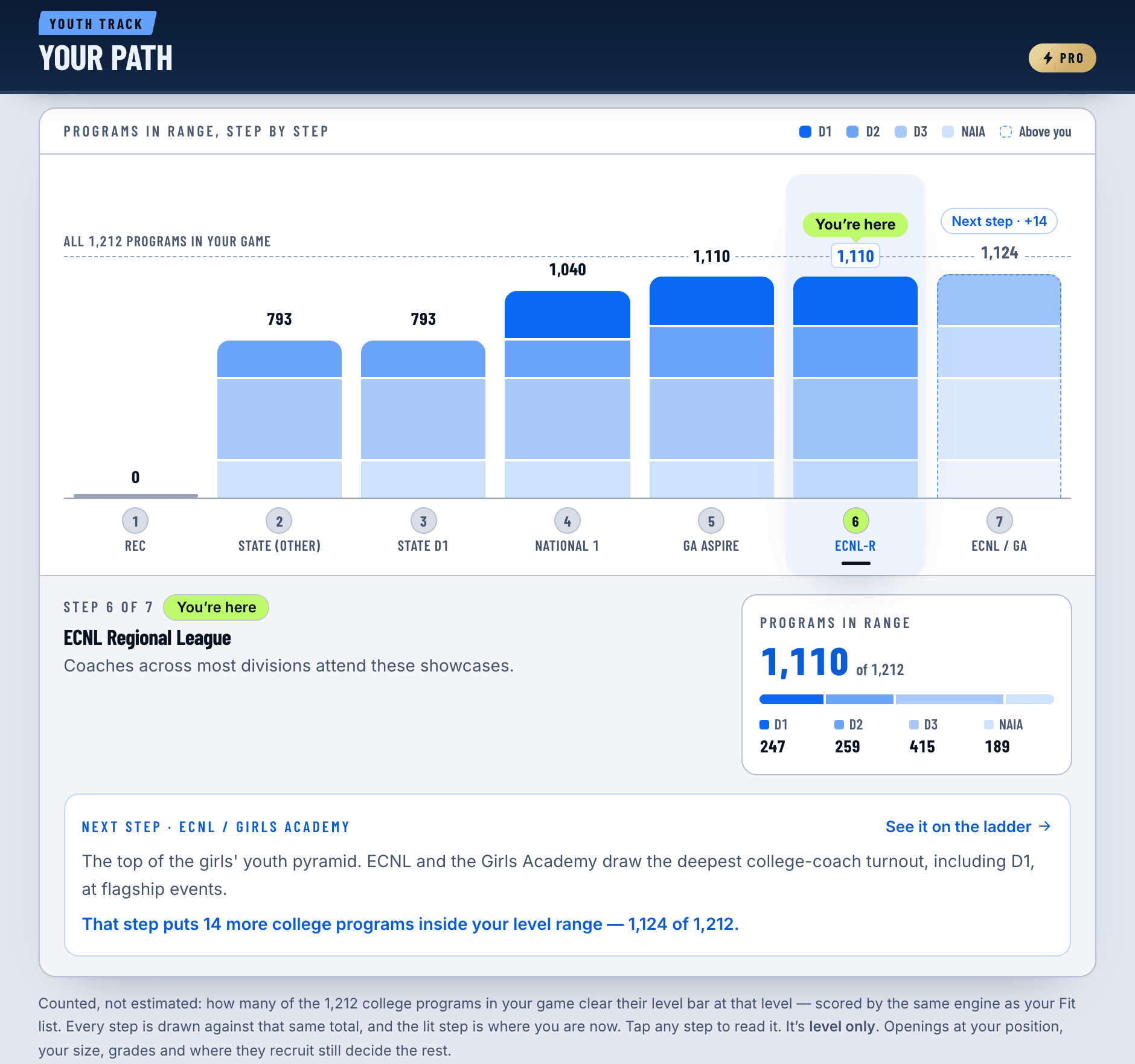
A screenshot of Startline with 3 regions highlighted and numbered, explained in the list below. - 1The level, placed — Where your player's club sits on the real board — MLS NEXT, ECNL, the Academy Division, ECNL Regional — and what the next level up actually is.
- 2Level only, and it says so — The ladder is about where a club plays, not how good your player is. The app says that under it in its own words.
- 3Counted, not ranked — Each level carries how many college programs clear it — a real count off the same engine as the Fit Score, not a reputation.
Sample player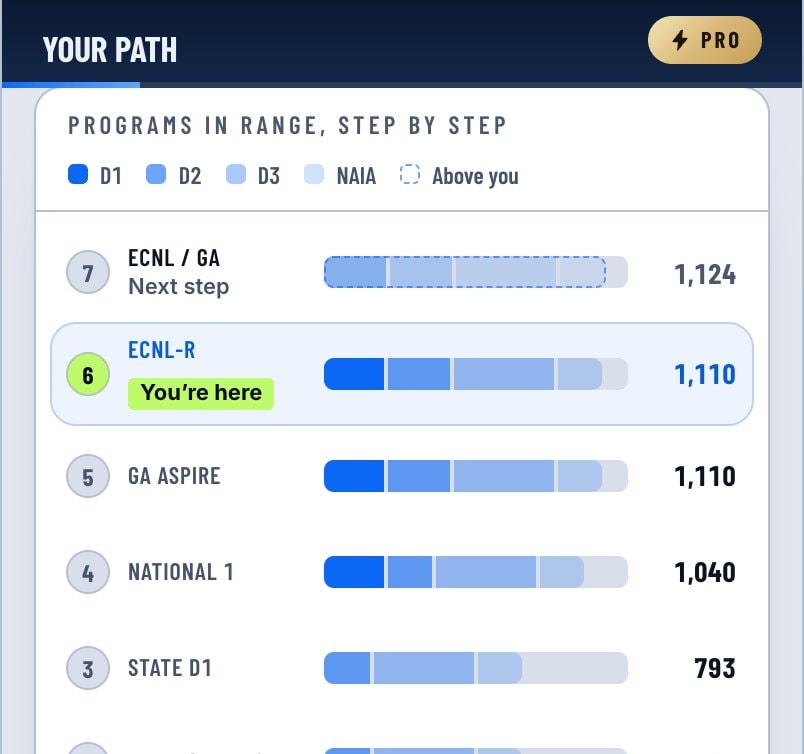
1/2 Where the player stands
- Step 2 of 5
Find clubs a level up
Your side, your state, the one-step-up clubs first. Every row says whether it is a step up or a lateral move.
1,150 clubsSample player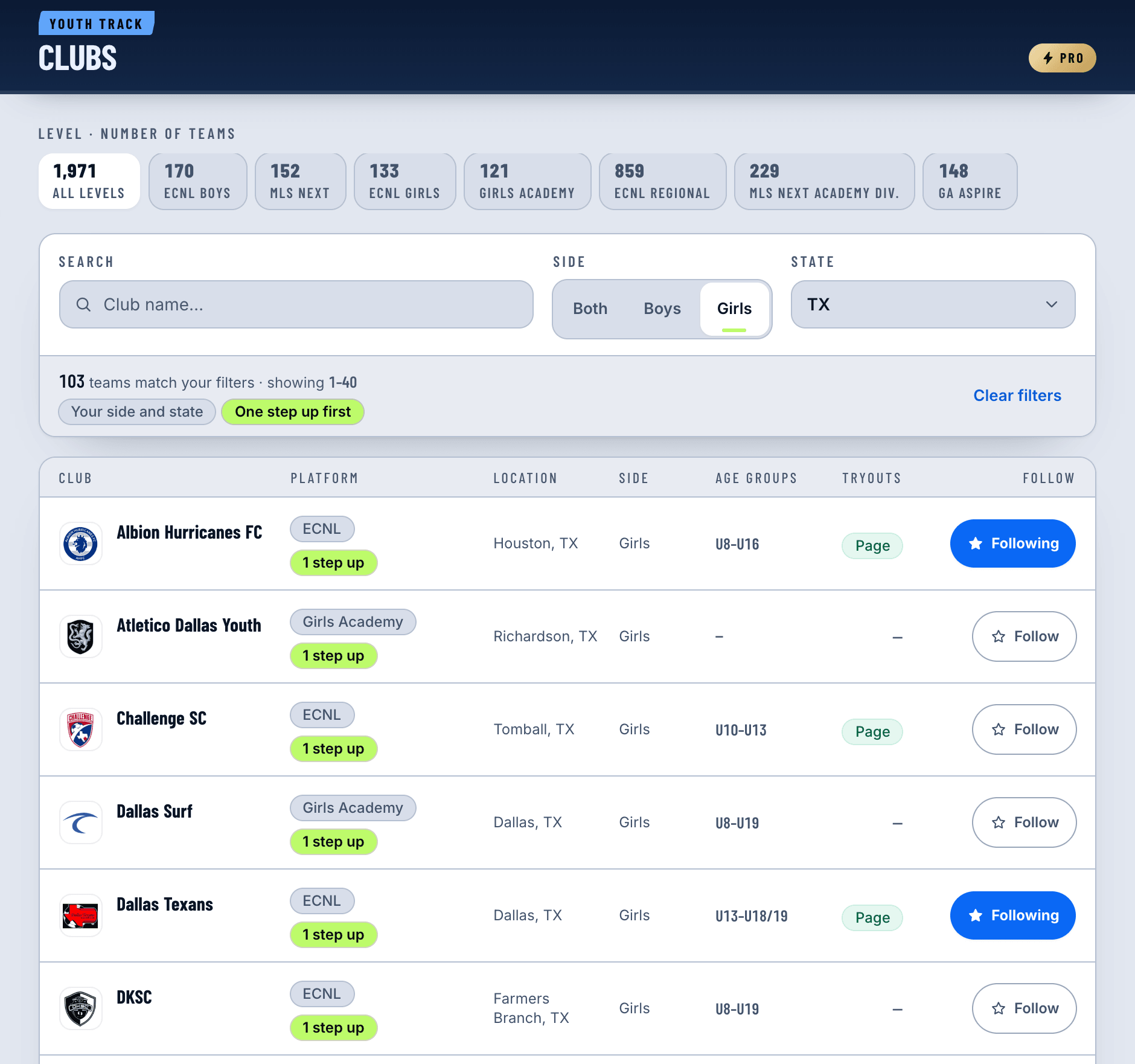
A screenshot of Startline with 3 regions highlighted and numbered, explained in the list below. - 1The league, on every row — MLS NEXT, ECNL, Girls Academy, ECNL Regional — so a step up is a thing you can see rather than a thing you're told.
- 2Where they actually are — City and state on every team, so you can tell a real drive from a nice idea on a map.
- 3Age groups and tryouts — The age groups a club fields, and whether it has a tryout page to link. Where we hold neither, the row shows a dash instead of guessing.
Sample player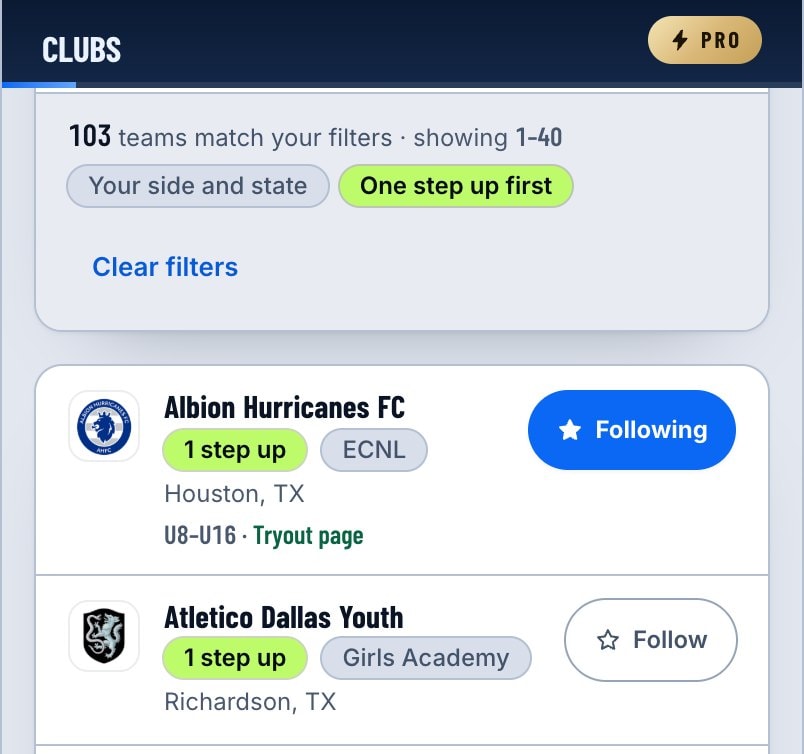
1/2 The club directory
- Step 3 of 5
Reach the age-group coach, not a front desk
A note to the people who pick the team, the director and your age-group coach, built from your profile and that club's real results. You send it.
6,700 staffSample player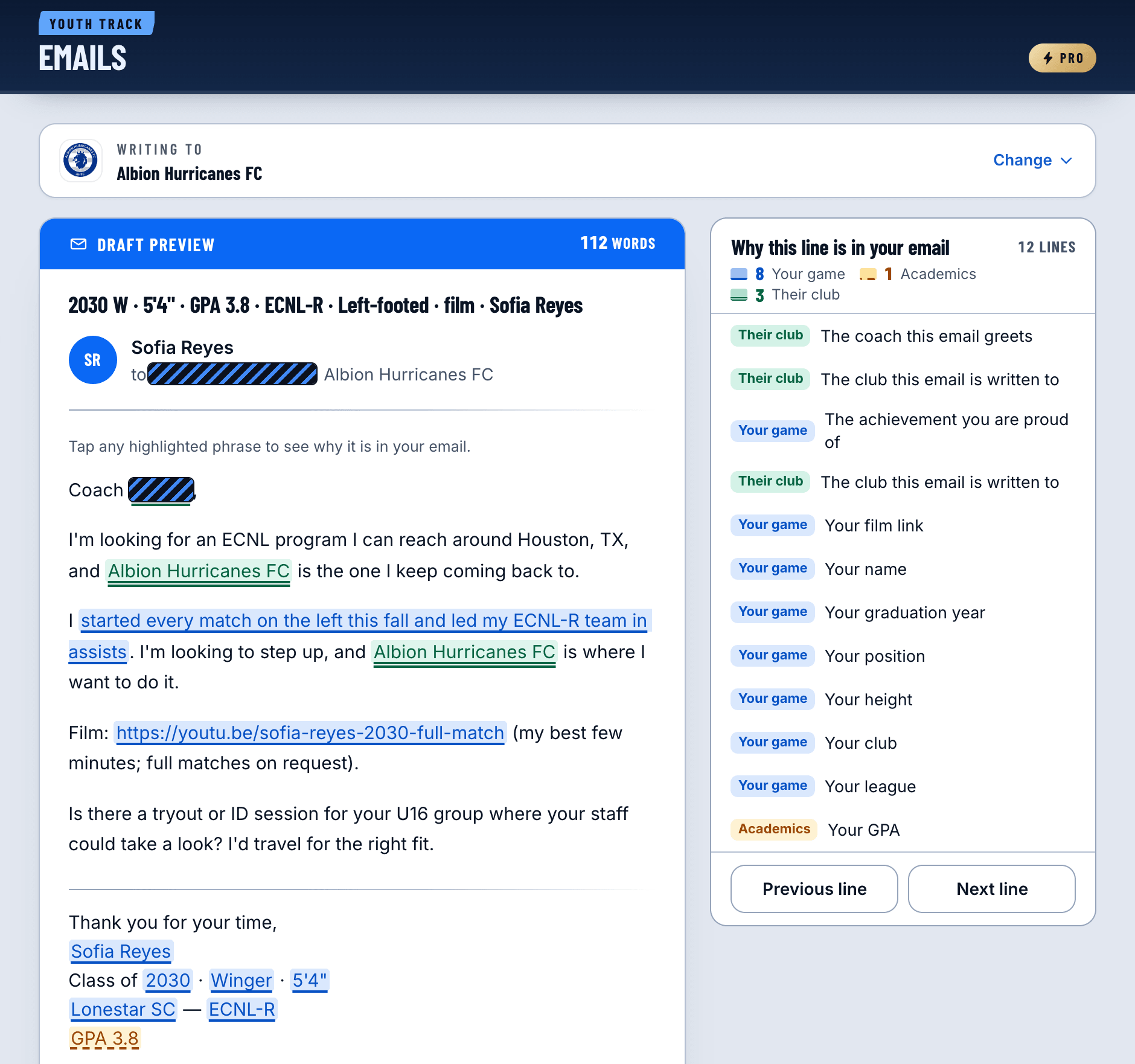
A screenshot of Startline with 3 regions highlighted and numbered, explained in the list below. - 1Opens with their level — The first line names that club's own platform and where it plays — the same rule the college drafts follow, so a director can tell in one line that it wasn't sent to sixty clubs.
- 2You send it — It opens in your own email app, from your own address. Nothing ever leaves on your behalf.
- 3Pick the club first — Any club you're following is one menu away, so the draft is aimed before a word of it is written.
Sample player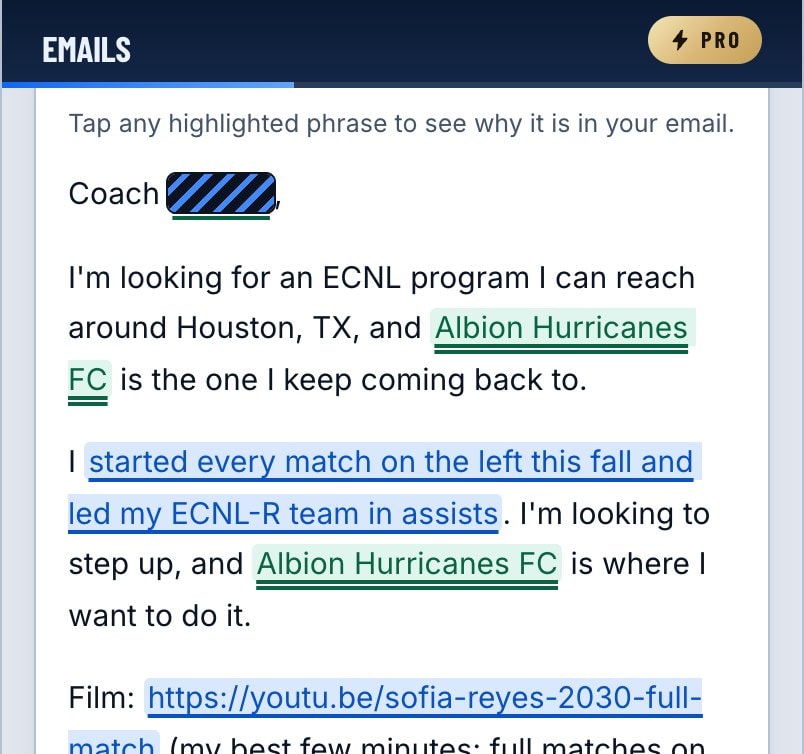
1/2 The email to the club
- Step 4 of 5
Get seen — tryouts & the ODP pathway
Each club's own tryout page, one tap away. Plus ODP, state by state: the one national route any player can try out for.
655 tryout linksSample player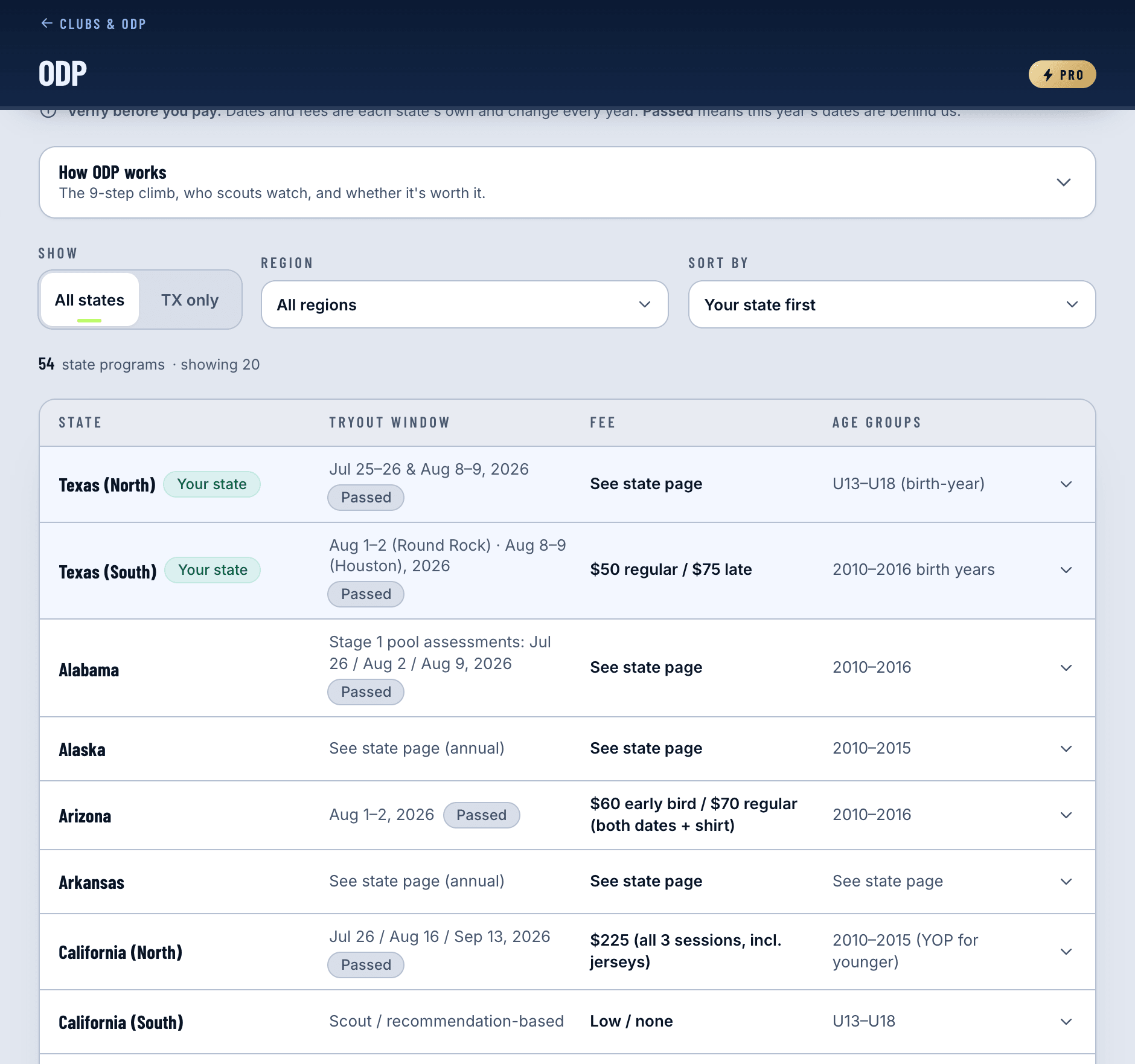
A screenshot of Startline with 3 regions highlighted and numbered, explained in the list below. - 1All 50 states — The Olympic Development pathway, state by state — the one route in this sport any player can try out for.
- 2The real tryout window — Read off each state association's own page. Where a state hasn't posted dates, it says so instead of inventing one.
- 3What ODP actually is — The one route in this sport a player can enter without being invited. Explained in plain words above the table, before any of the dates.
Sample player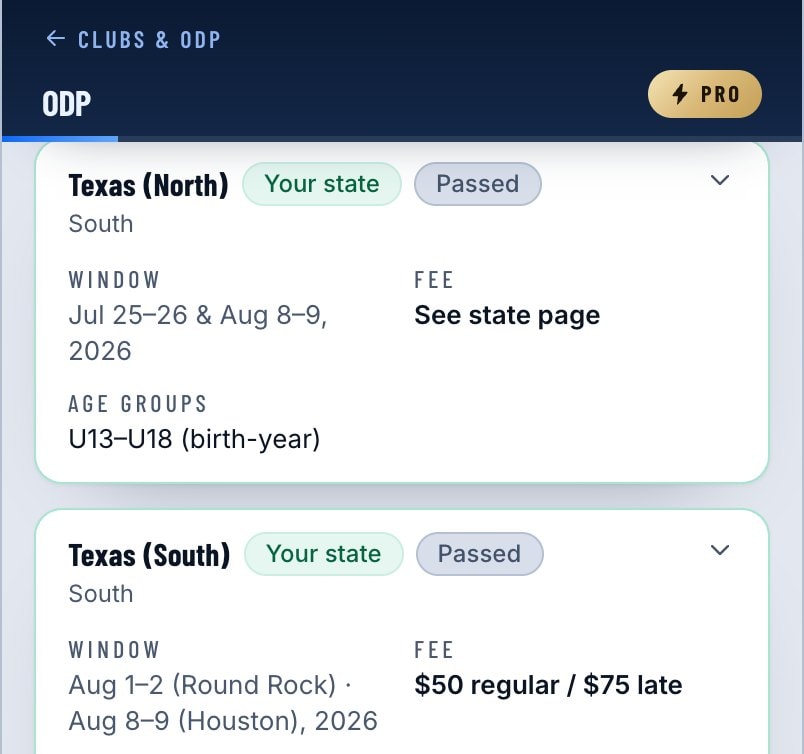
1/2 ODP, state by state
- Step 5 of 5
Track it all the way to a spot
One board holds every club conversation, from first message to a trial invite. After 14 quiet days a club's card drafts the follow-up.
first message → trialSample player · results illustrative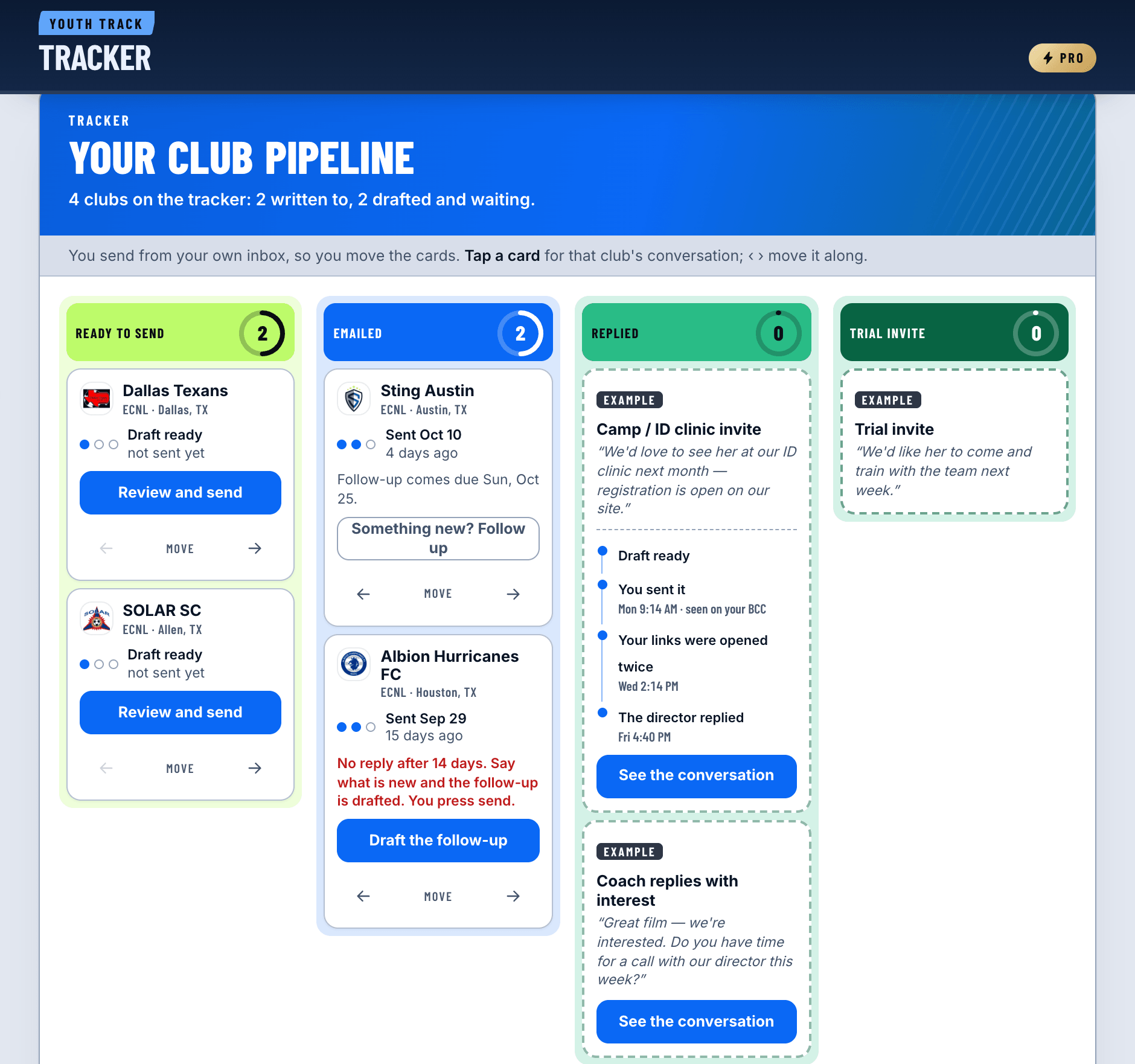
A screenshot of Startline with 3 regions highlighted and numbered, explained in the list below. - 1The same four stages — Ready to send, emailed, replied, trial invite. The college board's four, with the last one named for what actually happens at a club.
- 2Clubs on the college board — The same cards, carrying clubs instead of schools — so a family climbing now doesn't start again on a second system later.
- 3The nudge, dated — Every emailed club is dated, with its follow-up one tap away. Fourteen days of director silence is a second touch, not a no.
Sample player · results illustrative
1/2 Every club on one board
Soccer recruiting + AI
Powered by AI. Run by a person.
25 jobs keep Startline running, and 8 of them use AI, for words. The two Fit Scores are computed by fixed rules, so the same answers always give the same scores.
Writes in their voice
Two minutes of talking, and each coach email can be put in your player's own words. The facts in it do not change.
Reads school news daily
For the schools you follow, one line worth mentioning to the coach, with its link.
Rewords a reply on request
Say what you do not like about a drafted answer to a coach and AI rewords it, adding nothing new.
Reads their game film
Points to the moments worth keeping in a highlight reel, each with its time in the film. No rating.
The data behind the climb
Both ladders, mapped club by club.
Before Startline points you at a club it has mapped every league, the people who pick the teams, and last season's record at your age group.
1,971
club teams mapped
999 boys' · 813 girls' · 159 state-association — peak to grassroots
6,700
staff contacts
5,739 with an email on file · 650 named directors
3,471
age-group standings
last season's record at the age your player would join
655
tryout pages held
each club's own tryout page, one tap from your list
Every league, both paths
1,150 clubs
Strongest first, down to where the climb actually starts — so a move up is a real level change, not a new badge.
Boys
Girls
The open door: ODP
50 states
The one national pathway any player can try out for — no club pedigree required. It runs as a climb: your state, then your region, then the national teams.
54
state programs
4
regions
9
steps to the top
Scouts are watching from the State Team up — not just at the top. Every tryout scores the same 4 things, coast to coast.
Youth Track · the next club
Find your next club free
Build a profile and open the club directory. No credit card.
Before you start
What parents ask us at this stage
Does the league my kid plays in decide whether they get recruited?
It changes who is watching, not whether your player is good enough. A stronger league puts more college staff in the stands; it does not fill in a highlight reel or a position of need. Both still have to be there.
My player is 13. Is this too early to think about college?
For a college list, yes — and we won't build you one. What is not too early is knowing which clubs near you play at the next level up, who runs them, and when they hold tryouts. That is the whole Youth Track.
What is ODP, and is it worth it?
The Olympic Development Program — the state-association pathway, and the one route in this sport that any player can try out for without being invited. We hold all 50 states, with the real tryout window where the state has published one.
We're happy at our club. Is any of this for us?
Then use it as a map rather than an exit. 1,971 teams across 1,150 clubs, with age groups and named staff, tells you where your club actually sits — which is worth knowing even when the answer is "stay".